
What is Cache Augmented Generation (CAG)?
January 13, 2025
As 2024 came to an end, Cache-Augmented Generation (CAG) entered our lives and began to significantly transform the AI ecosystem. As we step into 2025, this development continues rapidly. However, before diving into CAG, let's briefly discuss Retrieval-Augmented Generation (RAG), a fundamental technology, to better understand this innovation.
What is RAG?
Retrieval-Augmented Generation (RAG) is a method that gives large language models the ability to retrieve information from external sources. Normally, a language model generates responses based solely on training data. However, with RAG, the model retrieves information in real-time from databases or memories and uses this information to generate more accurate and up-to-date responses.
For example, when a user asks "How were our company's sales in the last quarter?", the RAG system first retrieves reports related to "sales" from the database. Then, using this information, it generates an accurate answer: "The company's last quarter sales increased by 15% and targets were achieved." This way, instead of relying only on training data, the model can provide current, relevant information for each question.
However, RAG has some challenges:
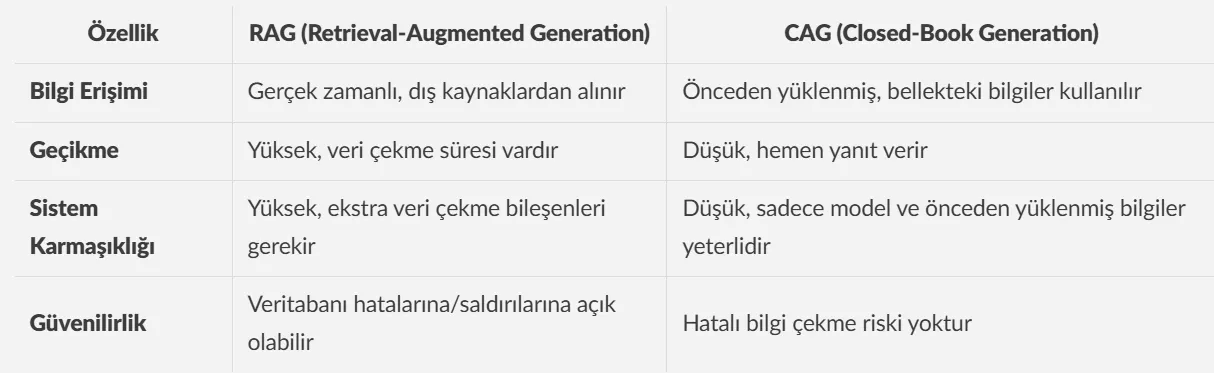
- Latency: Retrieving information from external sources for each query can take time. This means the model may not be able to respond immediately.
- System Complexity: It requires additional components like databases and embedding models, which can make the system more complex and significantly increase development time.
CAG: A Faster and Simpler Solution
This is where Cache-Augmented Generation (CAG) comes into play. Unlike RAG, CAG can work without needing real-time information retrieval. How? CAG loads all relevant data into the model's context window. This means the model always works with pre-loaded and ready information. There's no need to consult databases or external sources.

To better understand how this process works, let's go through an example:
Let's say we have a dataset about the company's annual report:
"The company grew 20% last year and entered the market with new product categories."
CAG pre-loads this information, and when a user asks "What is the company's growth rate?", since this information is already pre-loaded, the model responds quickly: "The company grew 20% last year."
Advantages of CAG include:
- Faster Responses: Since there's no need for real-time information retrieval, responses come immediately.
- More Reliable Information: Avoids risks of database errors or incorrect information retrieval.
- Simplified Structure: No additional data retrieval components are needed, making the system less complex.
Differences Between CAG and RAG
When Should You Use CAG?
CAG becomes an excellent choice when working with fixed and unchanging information. For example, in a system that requires fixed information for a company's customer support team, CAG can be a very efficient solution. Customer questions are usually standard, and this information doesn't change much over time, so using pre-loaded information is sufficient.
Example Use Cases:
- Customer support platforms: Frequently asked questions (FAQ) and product information.
- Education and knowledge management systems: Training materials, procedures, guides.
When Should CAG Not Be Used?
If you've worked with RAG models before, you've probably noticed that CAG doesn't replace RAG. RAG is an indispensable tool for situations that require real-time data thanks to its ability to retrieve information instantly from data sources. If your company's applications require responses based on current data or customized content, RAG will be a more suitable method. For example, an e-commerce platform must constantly keep stock and price information up to date, so RAG can provide accurate and current responses by instantly retrieving data from external sources. CAG falls short here because it cannot provide access to current data. Therefore, in an environment with dynamic data requirements, RAG's functionality and flexibility are incomparably more beneficial than the fast responses based on fixed data that CAG provides.
Some limitations of CAG can restrict its use cases. The first of these is the limited size of information. CAG requires all information sources to fit into the context window. This situation can make CAG less suitable for tasks working with very large datasets. Additionally, context window limitations are another important constraint. When working with very long contexts, the performance of large language models can decrease, which may require the model to focus on shorter and more concise responses.